In January 2026, my partner and I made a decision that changed everything about how we travel. After years of moving from Airbnb to Airbnb every few months, we decided to pause. To stay somewhere longer. To actually settle, even temporarily, rather than perpetually move.
The decision sounds simple. The reality was considerably more complicated because my partner and I don’t share a passport. I’m EU. He’s not. And that combination, when you want to live somewhere together for longer than three months, immediately narrows your options to almost nothing.
The Visa Question That Led Us to Georgia
We did what anyone does when they don’t know the answer: we typed it into Google. “Where can an EU and non-EU citizen live together for longer than three months without a visa?”
The answer, as far as we could find, was Georgia.
Not the American state. The country. Tucked between the Black Sea and the Caucasus mountains, bordered by Russia to the north and Turkey to the south. A country that, if we’re being completely honest, we knew almost nothing about when it appeared in our search results.
Georgia allows most nationalities to stay for up to one year without a visa. EU citizens, non-EU citizens, both — the policy is unusually generous and unusually straightforward compared to almost everywhere else. No visa runs. No complicated applications. Just arrive, live your life, and stay for up to twelve months.
We did more research. The more we read, the more we liked what we found. Affordable cost of living. A capital city — Tbilisi — with a growing remote work infrastructure. Good food. Interesting culture. A surprisingly warm welcome for foreigners.
So we booked a 10-month Airbnb in Tbilisi from Vietnam, where we were finishing our previous stay, and committed to figuring the rest out when we arrived.
This is what we’ve learned since.
Setting Up as a Foreigner: IE Registration and Banking
If you’re planning to work remotely from Georgia or run any kind of online business, registering as an Individual Entrepreneur (IE) is worth considering seriously. Georgia’s tax system for IEs is remarkably straightforward: 1% on turnover under 500,000 GEL. For anyone earning income online, it’s one of the most efficient setups available anywhere.
While still in Vietnam, we contacted PB Services, an agency in Tbilisi that helps foreigners with IE registration and banking setup. We were genuinely happy with their service; they handled the coordination, explained the process clearly, and made what could have been a stressful first couple of weeks considerably easier.
About a week after arriving in Tbilisi, we met with one of their representatives at the Public Service Hall. A remarkable institution, incidentally, that handles an enormous range of government services in one place with surprising efficiency. The IE registration itself was straightforward. From there, PB Services took us directly to TBC Bank to open our bank accounts.

Now, a few things about banking in Georgia that nobody warns you about:
Your registered address will be your home country address, not your Georgian one. The reason is that you cannot register a Georgian address as your legal address until you have a residency card. Residency cards take a long time. So for the foreseeable future, you’re legally registered at an address you no longer live at. This is normal, but it creates a downstream problem.
Bank statements don’t include your address. This means you cannot use a Georgian bank statement as proof of address because there’s no address on it. We asked for a Bank Reference Letter that stated our actual living address, which TBC provided. Some companies and institutions accepted this. Others insisted on a utility bill, which is simply impossible when you live in an Airbnb. This is an ongoing friction of Airbnb living in Georgia that has no clean solution. Be prepared to encounter it and have a backup plan.
Foreigners pay double. The fees listed on websites, for banking, for health insurance, for various services, are for Georgian residents. As a foreigner, you typically pay double. A 200 GEL fee becomes 400 GEL. This applies to banking and to health insurance. We got our health insurance through GPI, and while the double-rate is real, the absolute cost is still very reasonable by European standards. Budget for it.
Check everything in person, twice. Large companies and institutions in Georgia make administrative errors frequently: typos in names, wrong details on documents, and incorrect amounts. This is not a criticism so much as a practical reality. When you are physically in an office, check every document before you leave. Corrections that could have been made on the spot take weeks when handled remotely. We learned this lesson once and applied it rigorously after that.
The Traffic: Organised Chaos Is Being Generous
Nothing in our research prepared us for Tbilisi traffic.
The city operates on a system that functions, somehow, despite appearing to have no rules. Lanes are suggestions. Horns are communication tools. The concept of right of way is interpreted creatively by all parties simultaneously. When we take a Bolt taxi, I have developed a personal strategy of closing my eyes and hoping for the best.
And the noise. Tbilisi traffic noise is constant, pervasive, and operates at all hours. If you’re considering a long stay, factor this in when choosing your apartment. A flat on a main road in Tbilisi is a fundamentally different experience from one set back from traffic, and the difference in daily quality of life is significant. Ask specifically about traffic noise when browsing listings, and read reviews for any mention of it.
The good news: Bolt works excellently in Tbilisi and is genuinely affordable. It’s our primary way of getting around and we’ve never had a serious problem with it.
Groceries and Food: The Real Picture
Groceries in Tbilisi are not super cheap, but they are very affordable by Western European standards. A weekly shop for two people costs a fraction of what it would in the Netherlands or the UK.
The challenges are specific rather than general. Meat variety and affordable meat options are harder to find than we expected. Vegetable variety is more limited than we were used to — the leafy greens and specific vegetables we’d relied on in other countries are either unavailable, expensive, or inconsistent in quality. We’ve adapted, largely, by building our cooking around what is plentiful and good: potatoes, carrots, onions, peppers, tomatoes, and seasonal produce that varies through the year.
Frozen mixed vegetables have become a reliable fallback and are available in most supermarkets. Not ideal, but practical.
Wolt and Glovo both operate in Tbilisi and are excellent for food delivery and grocery delivery. When work is busy, or neither of us wants to go out, both apps cover the gap reliably. If you use Wolt, tip your driver. They work hard, the pay is modest, and they genuinely appreciate it.
The Food Itself: Eat Everything
Separate from grocery shopping, the Georgian food scene is something we were not prepared for and have loved completely.

Khachapuri. The boat-shaped bread filled with melted cheese and topped with an egg and butter is as good as everyone says, and better than it sounds.
Khinkali. Large dumplings filled with spiced meat broth require a specific technique to eat without disaster (bite carefully from the top, drink the broth first) and are worth every attempt.
Kupati. Georgian sausage is excellent.
The city is scattered with small bakeries selling fresh pastries at very low prices. Georgian restaurants range from simple neighbourhood spots to more formal settings, and the quality across the range is consistently good.
If you’re coming from a country where food is a significant expense, the combination of Georgian restaurant prices and the quality of what you get will be a genuine and recurring pleasure.
The Buildings: Noise Is Part of Life Here
We should be honest about this, particularly for anyone sensitive to noise.
Georgian buildings, especially the Soviet-era apartment blocks that make up a significant portion of Tbilisi’s housing stock, have thin walls. Thin floors. Limited sound insulation between units. You will hear your neighbours. Not occasionally. Regularly.
Georgians, as a generalisation, are not quiet people. Conversations happen at volume. Furniture gets moved. Music plays. This is not inconsiderate behaviour — it’s cultural. The expectation of acoustic privacy between apartments that exists in, say, northern Europe simply doesn’t apply here in the same way.
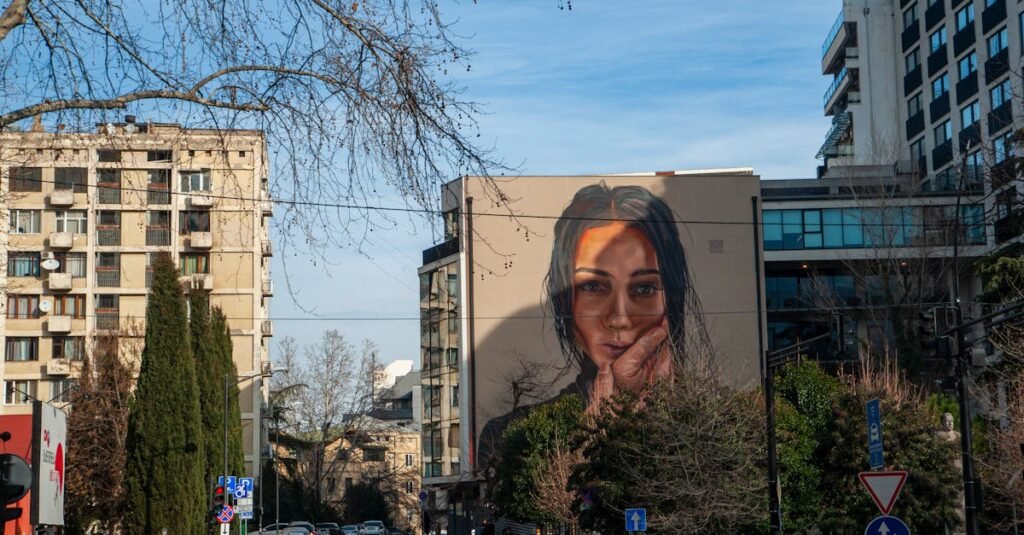
After three months, we have adapted to this more than we expected to. It took time and it took tools: a white noise app (we use rain sounds, which genuinely helps), foam earplugs for the worst nights, and occasionally noise-cancelling headphones. None of these eliminates the noise. All of them make it manageable.
If you are a light sleeper, factor this in carefully. If possible, choose apartments higher up in the building and away from main roads — they tend to be quieter. Read reviews specifically for noise mentions before booking.
Air Quality and Health
This one caught us off guard. Tbilisi’s air quality is not great. The combination of traffic, the city’s geography (it sits in a valley which traps pollution), and high pollen levels creates a challenging environment for anyone with respiratory sensitivities.
We bought both an air purifier and a humidifier within the first month. The dry air specifically caused constant sneezing and general discomfort until we addressed it. If you’re planning a long stay, budget for both. They’re widely available in Tbilisi and not expensive, and the difference to daily comfort is noticeable.
The People: Warm, Patient, and Quietly Proud
Most Georgians are genuinely warm toward foreigners. There is a notable appreciation when you make any effort to speak Georgian — a language that is entirely unlike anything most Western Europeans have encountered, with its own unique script and sound system.
I’ve been practising with Bolt taxi drivers, who have proven to be patient and encouraging teachers despite my frequent mispronunciations producing expressions of genuine bafflement. There is something charming about attempting a language and having the other person correct you with a grin rather than switching immediately to English.
Georgian as a language is difficult. The script alone takes time to learn. But even learning a few basic words: hello (გამარჯობა / gamarjoba), thank you (გმადლობთ / gmadlobt), delicious (გემრიელია / gemrielia) is received with warmth that makes the effort worthwhile.
The Honest Overall Assessment
We didn’t choose Georgia from a place of excitement or wanderlust. We chose it because it was the practical answer to a specific problem: where can an EU and non-EU couple live together for a year without visa complications.
What we found was more than a practical solution.
The beginning was hard. Sleep deprivation from noise, administrative friction, a series of paperwork corrections, the disorientation of a new city with a different language and script. There were moments in the first three months where we questioned whether we’d made the right call.
Four months in, those moments have largely passed. We’ve found our rhythm. We know which bakery we like, which supermarket has what we need, which route avoids the worst traffic, and how to navigate the specific bureaucratic quirks of this country. Tbilisi is starting to feel, in the way that only comes with time, like somewhere we actually live.
We don’t regret it. And that, after the start we had, is genuinely something.
Useful Apps for Living in Tbilisi
- Bolt — taxi, reliable and affordable
- Wolt — food and grocery delivery (tip your driver)
- Glovo — alternative to Wolt for delivery
- TBC Bank app — banking, works well once set up
- GPI app — health insurance management
- Google Translate — Georgian script mode is genuinely useful in shops and restaurants
The Practical Summary for EU/Non-EU Couples Considering Georgia
- Visa: most nationalities can stay up to 1 year without a visa — check your specific passport
- IE registration: PB Services or similar agencies make the process straightforward
- Banking: expect double fees as a foreigner, no address on statements, get a Bank Reference Letter
- Health insurance: GPI works well, double rate for foreigners but still affordable
- Proof of address: prepare for this to be an ongoing challenge when living in an Airbnb
- Noise: factor it in heavily when choosing an apartment
- Air quality: budget for an air purifier and humidifier
- Traffic: constant, occasionally alarming, perfectly functional
Also check out:
- Noisy Neighbours in an Airbnb: What Actually Helps
- How to Cook and Shop for Long-Term Airbnb Living
- Why Every Airbnb Guest Should Document Everything on Arrival
- Wi-Fi, Workspaces and Staying Connected: The Remote Worker’s Guide
Because when your Airbnb feels more like home, everyone wins.