Let’s be honest about something that most Airbnb content glosses over entirely: noisy neighbours are one of the hardest and most common challenges of long-term Airbnb living — and there is no perfect solution.
This isn’t an article that pretends otherwise. We’ve been living in Airbnbs for nearly seven years, and noise from neighbouring apartments has followed us across more countries than we’d like to admit. Everything from the completely unavoidable — toilets flushing, furniture scraping, the sound of someone else’s television through a thin wall — to the genuinely disruptive: loud music at midnight, shouting matches, bass that comes up through the floor.
This article is not about fixing the problem, because in most cases you can’t. It’s about coping with it more effectively, handling it more wisely, and adjusting your expectations to something more realistic — without just accepting that you have to suffer through it.
The Noise You Can’t Do Anything About — And Why It’s Worse Than You Think
There are two categories of neighbour noise in an Airbnb, and they’re worth separating clearly because they require completely different responses.
The first category is what we call living noise. Toilets flushing. Footsteps on the floor above. A neighbour’s television at low volume through the wall. Furniture being moved. A door closing. The general hum of people living their lives in the adjacent unit.
This is not anyone doing anything wrong. It’s the sound of a building being inhabited — and in a building with thin walls, poor insulation, or old construction, it travels. A place can look like a million euros and sound like a cardboard box. There is absolutely no correlation between how beautiful a listing looks in the photos and how much you’ll hear through the walls. We’ve stayed in stunning apartments that were acoustically awful, and modest ones that were blissfully quiet.
The difficult thing about living noise — and this takes most long-term Airbnb guests by surprise — is that it accumulates. In the first week you barely notice it. By week four it has become the thing you think about when you’re trying to fall asleep. You can’t ask a neighbour to stop flushing their toilet. You can’t reasonably request that they walk more quietly or move their furniture less. The noise is legal, it’s normal, and it’s not going anywhere.
What makes this worse is that people have different rhythms. Someone who works late comes home at 22:00 and their evening is only beginning. That’s not inconsiderate — it’s just a different schedule. But when you’re trying to sleep at 23:00 and someone two floors up is scraping chairs across a hard floor, the reasonableness of their behaviour is cold comfort.
What actually helps with living noise:
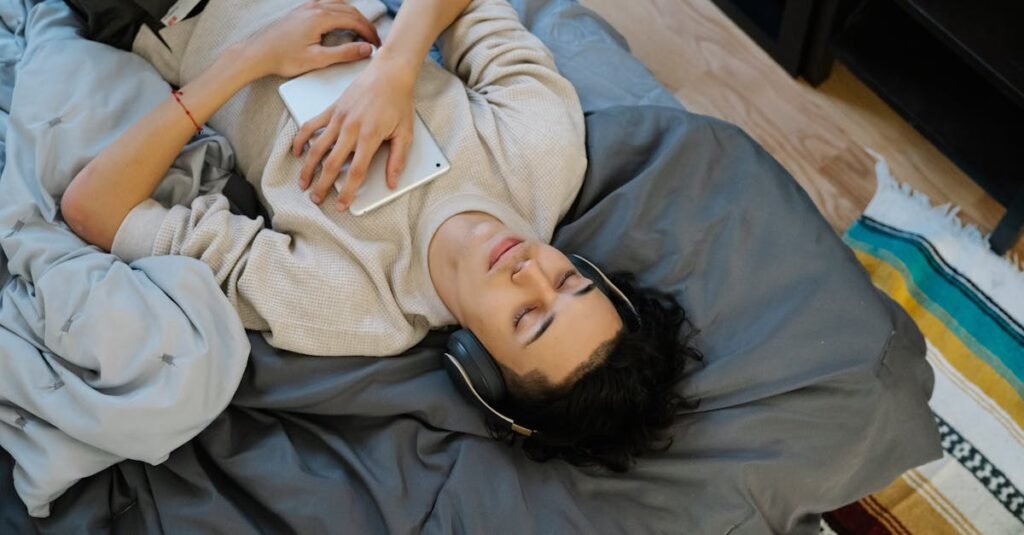
The most effective tool we’ve found — and we say this from current, lived experience as we write this — is a white noise app. Listening to rain sounds through headphones while falling asleep has made a genuine difference to our ability to sleep through the kind of low-level noise that a building produces at night. It’s cheap (many white noise apps are free), it’s practical, and it works in a way that nothing else we’ve tried quite matches.
Foam earplugs are the other option — inexpensive, available in any pharmacy, and effective for blocking out consistent noise. Some people find them uncomfortable for sleeping. For others they’re the perfect solution. Both are worth trying.
Neither of these eliminates the noise. They make it manageable, which is the realistic goal.
When the Noise Is Someone Choosing to Be Disruptive
The second category is different: noise that’s the result of someone actively making a choice that affects you. Loud music, persistent loud television, parties, shouting. This is not living noise — this is behaviour, and behaviour can sometimes be changed.
We’ve been on both sides of this experience, and the outcomes have been almost entirely shaped by how we approached it.
In Pristina, Kosovo, we had a neighbour who played loud music during the day — consistently enough that it was genuinely affecting our ability to work from home. We knocked on his door, introduced ourselves, and asked politely if he could turn it down slightly. We explained we were working from home and struggling to concentrate. He was immediately apologetic, turned it down, and from that point on it was never an issue again. He became one of the friendlier elements of that stay.
In Kotor, Montenegro, we tried the same approach with a woman who played music throughout the day. The response was the opposite — she started shouting at us and turned the volume up. The host couldn’t resolve it. We eventually left early and moved to a different apartment.
Same approach, completely different outcomes. The approach was right in both cases. The outcome depends on the person, and you cannot control that.
What you can control is how you handle it — and these are the principles that have served us best:
Always record everything. Video is better than audio. Timestamped is better than either. Whenever noise is disruptive enough that you might need to raise it — with a neighbour, with the host, or with Airbnb Support — you need documentation. A recording of loud music at 1am is evidence. Your word against a neighbour’s is not. Get it on record every time, even if you’re not sure you’ll need it.

Talk to your host before confronting the neighbour directly. The host has a relationship with the building that you don’t. They may know the neighbour, they may have existing house rules, they may have had the same issue with previous guests and already have a way of handling it. In our current situation, our host spoke to the neighbours twice — it took two conversations, but the loud music after 23:00 has stopped. It wasn’t instant, but the host’s involvement made the difference.
In the evening and at night, you have significantly more leverage. Most countries and municipalities have quiet hours — typically from 22:00 or 23:00 onward. If someone is playing loud music at midnight and you have a video recording of it, you have a legitimate and documentable complaint that the host can act on and that Airbnb Support can consider if escalation becomes necessary.
During the day, your leverage is limited. This is the harder truth. Someone playing music in their own apartment at 2pm is within their rights in almost every jurisdiction, regardless of how much it’s affecting you. Knocking on the door and asking politely is the most you can do — and sometimes, like in Pristina, it’s enough.
What Not to Do
We’ve seen — and felt the temptation of — responses to neighbour noise that don’t help and usually make things worse.
Don’t retaliate. It escalates. Every time. The neighbour who feels retaliated against becomes a neighbour who has a grievance, and that changes the dynamic from “noise issue” to “conflict” in a way that’s much harder to resolve.
Don’t let frustration shape how you communicate. Messages sent to hosts in the middle of a bad night rarely land as well as messages written in the morning. If you’re going to raise something in writing, do it when you’re calm and factual. Tone matters — a host who receives an aggressive complaint is less motivated to help than one who receives a clear, documented, reasonable one.
Don’t assume the host is indifferent. Some are. But many genuinely want to help and simply don’t know there’s a problem. Give them the information, give them a reasonable amount of time to act, and keep a record of both.
The Mindset That Actually Helps
We want to be honest about this because it took us years to really internalise it: some noise situations in Airbnbs don’t have a solution. The building is old. The walls are thin. The neighbour has no intention of changing their behaviour. The host has done what they can. And you’re still there, for weeks or months, trying to live your life.
In those situations, the question isn’t “how do I fix this?” — it’s “how do I get through this without it ruining the stay?”
Knowing you’ll leave eventually helps more than it sounds. Not as a reason to accept genuinely unacceptable situations — if something is affecting your health or safety, that’s a different matter and you should involve Airbnb Support and consider leaving. But for the persistent low-level noise that most long-term stays produce at some point, the knowledge that this is temporary changes how it sits. You’re not trapped in this building forever. You have an end date.
That doesn’t mean the noise doesn’t matter. It means it doesn’t have to define the whole experience.
What We Actually Use Right Now
Since we’re living through this as we write it, here’s exactly what’s in our current toolkit:
- A white noise app — free, running every night, listening to rain sounds. Genuinely the most effective thing we’ve tried.
- Foam earplugs — for the nights when the white noise isn’t quite enough
- Video recordings — documented, timestamped, saved and ready if we need them
- Written communication with the host through the Airbnb app — a record of every conversation about the issue
None of this is glamorous. But it works well enough to make a difficult situation manageable — which is the realistic goal when dealing with something you can’t fully control.
A Note on Listings and Reviews
One final thought for guests: when you read a review that mentions noise — from neighbours, from the street, from the building — take it seriously. Don’t let a host’s response of “it was just a one-off” override what another guest took the time to document. They were there. They experienced it. Their review is more reliable than the host’s assessment of their own listing.
And when you leave your own review: mention the noise if it was significant. Future guests deserve to know. It’s one of the most useful things you can include — and one of the things most guests leave out.
Also check out:
- Why Every Airbnb Guest Should Document Everything on Arrival
- How to Read Airbnb Reviews (And Spot What Guests Aren’t Saying)
- How to Feel at Home in an Airbnb (Long-Term Stay Guide)
- Moving to Tbilisi as an EU/Non-EU Couple: Honest Guide
Because when your Airbnb feels more like home, everyone wins.